Speculative input→Playable modality
I did not have to storyboard yelling. I could ship a mapping as a prototype, sit with it, and feel whether volume actually drove like a throttle.
01What experimenting with a voice-controlled racer taught me about unusual inputs—and how AI made that modality cheap enough to try.
Role
Designer & developer
Period
July 2026
Format
Browser multiplayer racer
Disciplines
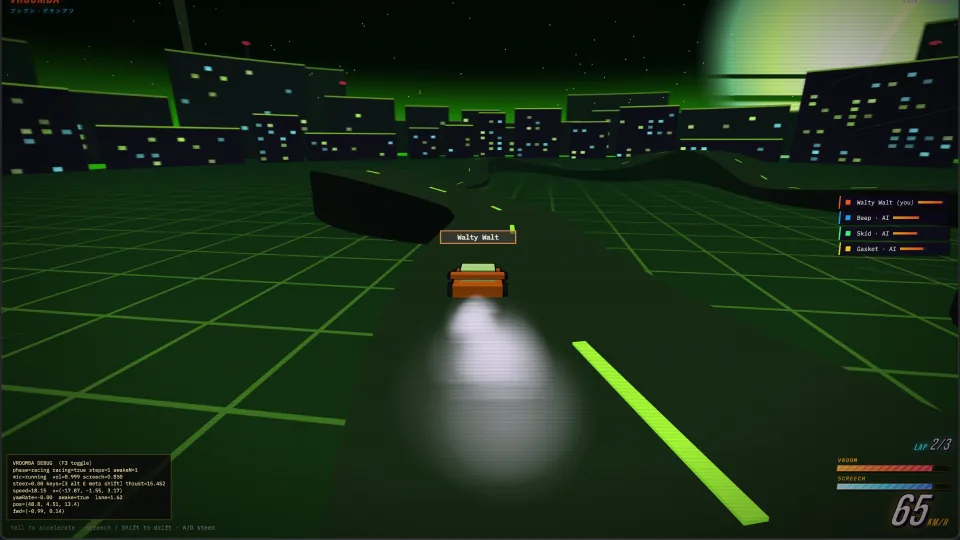
I built Vroomba in July 2026: a browser racer you drive with your voice. Yell to go. Screech to drift. Steer with the keys.
Unusual inputs are usually expensive to try. You need audio pipelines, recognition, feel tuning, and a room of people willing to shout. AI shortened that loop enough that I could test the idea by driving it, not by writing it up.
The question was not whether voice could control a car. It was whether a messy, performative modality could feel like a race before I talked myself out of building it.
Yell
to accelerate
Screech
to drift
A / D
to steer
AI
fills empty grid slots
Voice is a messy input. Volume, pitch, and room noise do not behave like keys. Because implementation was cheap, I could try a mapping, play it, and keep the version that still felt like driving.
I did not have to storyboard yelling. I could ship a mapping as a prototype, sit with it, and feel whether volume actually drove like a throttle.
01Voice only deserved the slot if it felt better than holding W. The unusual modality had to be the game, not a gimmick on top of a normal racer.
02Volume curves, drift triggers, and engine presence could change in a session. AI made the messy parts of a new modality cheap enough to try twice.
03Speed made the first version easy. The work was noticing when a novel input was still just a novelty.
04The useful speed was not shipping more features. It was throwing away a volume curve, a drift trigger, or an engine mix in the same sitting, then driving the next one.
Mapping volume to speed is easy to describe. Finding the range that feels like an engine, not a shout-off, took sitting in a room and driving each curve.
Screech has to fire on purpose and stay quiet when someone just gets excited. I could try pickier and looser triggers until the modality felt like a choice, not a glitch.
AI made it cheap to try a worse volume curve or a different engine mix. The design work was discarding the versions that still felt like a demo.
I ended up with a playable racer, but what stuck was how quickly I could try a strange input. AI made the audio and mapping work cheap enough to prototype in a sitting. The work I still have to get better at is noticing when a clever modality is just a demo.
I could not judge yelling from a storyboard. The only way to know if the modality was fun was to drive it.
The useful speed was not more features. It was trying a worse curve, discarding it, and driving the next one in the same session.
AI made the first mapping cheap. It did not tell me when a clever input was still just a novelty.