Static artefacts→Live systems
The working product became the primary design material. I could judge movement, latency, hierarchy, and game feel together instead of approximating them across separate deliverables.
01What building a multiplayer browser FPS taught me about product design when the distance between critique and implementation collapses.
Role
Designer & developer
Period
August 2026
Format
Browser multiplayer FPS
Disciplines
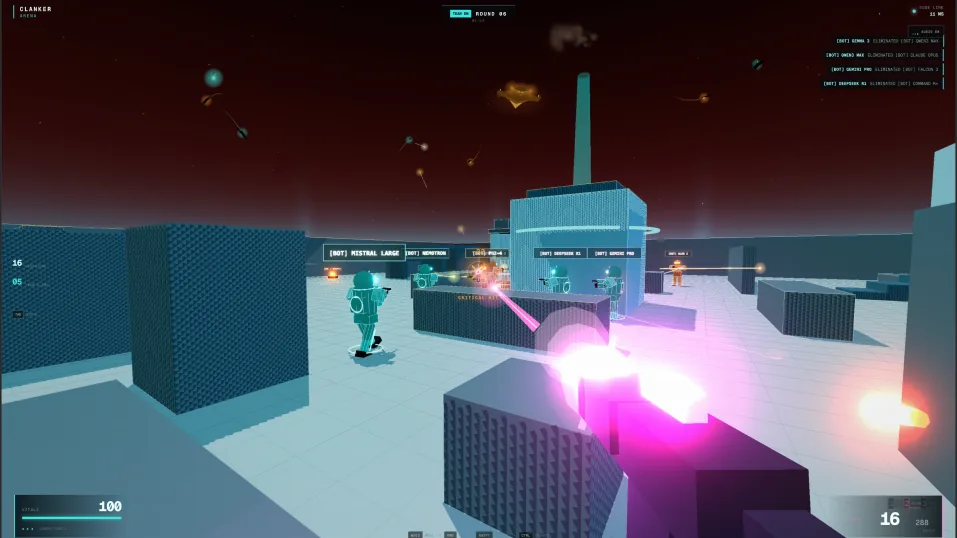
I built Clanker Arena for a challenge at AWS Dev Day 2026 in New Zealand. The brief I set myself was simple: a real-time 3D multiplayer game, designed and in production within 45 minutes. It shipped, winning OpenAI swag and $2,000 in credits.
But the game was really a test of a broader product-design question. If I can move directly from an observation to working software, does my role become less important, or does the work move somewhere else?
The answer emerged through playtesting. Faster execution did not remove design work; it moved the bottleneck from producing artefacts to framing problems, reading behaviour, making systems-level decisions, and knowing when a plausible result was still not good enough.
45m
to the first playable experience
5
game modes
12
distinct map themes
32
players per room
The meaningful change was not simply that screens or code were faster to make. It was that research, interaction design, implementation, and validation could happen inside one continuous loop, using the live product as the shared source of truth.
The working product became the primary design material. I could judge movement, latency, hierarchy, and game feel together instead of approximating them across separate deliverables.
01A product observation could become a tested implementation in the same session. I could move from describing intent to carrying it through the system.
02Prompts improved when they defined the experience and its success conditions: buildings must be enterable, stairs must be traversable, and hits must resolve against what the player saw.
03AI made plausible output abundant. The scarce work became noticing what was wrong, finding the underlying product model, and maintaining a coherent quality bar across rapid change.
04Code as design material
Those limits usually arrive as constraints handed down after the design is finished. Because implementation was cheap, I could neogitate different budgets, play the result, and keep the version that still felt honest.
Raising particles, geometry, and operator count was easy. The design work was feeling the moment the frame budget broke, especially when movement stopped being crisp and the fight became hard to read.
A thinner tick rate and cheaper reconciliation made rooms easier to keep alive. They also made combat resolve against a slightly different fight than the one on screen. The requirement stayed experiential: a valid shot must land on the opponent the player actually saw.
I could push occupancy, bot load, and authoritative state until a room stopped feeling immediate. The useful number was not the maximum the edge could hold, but the budget at which 32 operators still felt like one shared fight.
I ended up with a playable multiplayer FPS, but what stuck with me was simpler. When making is this cheap, I can produce plausible ideas faster than I can tell which ones are any good. The work I have to get better at is noticing what feels wrong, deciding how it should behave, and checking whether it actually works for someone.
Working software replaced the gap between a design artefact and its eventual interpretation. I could evaluate decisions in context, not just explain them.
The quality of my observations, what feels wrong, why it matters, and how success should behave had more impact than the volume of generated output.
Interaction quality crossed rendering, input, physics, networking, rules, and content. AI helped me traverse the stack; a coherent product model held it together.
Faster production can simply ship the wrong idea sooner. Keeping playtesting inside the generation loop stopped me from treating plausible output as accepted output.
Try the result